Showing posts with label History. Show all posts

Happy Ides!

 
Today is the Ides of March a famous day in European history because of Brutus, Cassius and a bunch of other Roman dudes.

Did you ever wonder what an "ide" was. Here's the explanation from Wikipedia [Ides of March].
The word Ides comes from the Latin word "Idus" and means "half division" especially in relation to a month. It is a word that was used widely in the Roman calendar indicating the approximate day that was the middle of the month. The term was used for the 15th day of the months of March, May, July, and October, and the 13th day of the other months.
I think you have to be more than 50 years old to appreciate this skit. You might have to be Canadian.1


1. Wayne & Shuster are graduates of the University of Toronto.

USA Honors Two Biochemists and an Evolutionary Biologist


The United States has just honored two biochemists, an evolutionary biologist, and some other scientist by issuing stamps to commemorate their achievements [American Scientists (Forever)].

Melvin Calvin (1911-1997) is famous for working out an important pathway of carbon fixation known today as the Calvin cycle. This pathway is prominent in photosynthetic bacteria and in chloroplasts. It is often considered to be a fundamental part of photosynthesis, although some workers prefer to maintain the distinction. Calvin won the Nobel Prize in Chemistry in 1961.


Severo Ochoa (1905-1993) received the Nobel Prize in Physiology or Medicine in 1959 along with Arthur Kornberg. Ochoa demonstrated that RNA could be synthesized in vitro using purified RNA polymerase. Later on he helped create synthetic polynucleotides that helped crack the genetic code.

Asa Gray (1810-1888) is best known today as a friend of Charles Darwin and one of the early supporters of evolution in America. He was a botanist at Harvard for most of his career. The website says he "... became the principal American advocate of evolutionary theory in the mid-nineteenth century." I think it would be much more fair to say that Asa Gray was a strong supporter of evolution. He and Darwin had many discussions (by letter) on the mechanisms of evolution.


Happy Birthday from Google!


Google wishes happy birthday to ..... ?


John Lennon (1940 - 1980)

 
John Lennon died on Dec. 8, 1980 when he was shot four times in the back by Mark David Chapman. His ashes were scattered by Yoko Ono in Central Park in New York at the site of the Strawberry Fields Memorial.

That was thirty years ago today. A whole new generation has grown up since then and I fear we are in great danger of forgetting what Lennon and The Beatles did to help change our culture for the better.


The Pillars of the Earth

 
Last night we watched the first two episodes of The Pillars of the Earth. They were fantastic. The story takes place in England during the time after the death of Henry I (1068-1135) and the civil war between Stephen and the Empress Matilda (Maud).1 This is near the end of my favorite period of history—the so-called dark ages.

Judging by the first two episodes, the show does a pretty good job of capturing the flavor of the era except that everyone looks far too healthy and beautiful. They all have good teeth.


Here's a brief history.

Henry I (1068-1135) is the King of England [Henry Beauclerc] who dies at the beginning of the series. He was the youngest son of William the Conqueror and took the throne of England (and the Duchy of Normandy) from his older brothers after much fighting.

Henry had two surviving legitimate children: Matilda (1102-1167) and his heir William Adelin (1103-1120). William died when he was only 17 years old when The White Ship sank on Nov. 25, 1120 during a voyage from France back to England. The sinking of the White Ship is the opening scene of the movie. (The ship set sail at night and smashed into a rock. Most of the crew and passengers were drunk. Everyone died of exposure.)

Matilda married Henry V, Holy Roman Emperor, when she was 13 years old and she became known as Empress Matilda at that point. She returned to England when her husband, Henry V, died in 1125. In the movie she is depicted as a young girl who is present when the King learns of his son's death on the White Ship. In fact, she was already 18 years old and married to the Holy Roman Emperor when the ship went down.

Empress Matilda, known as Maud in the movie, married Geoffrey Plantagenet, Count of Anjou in 1128. They had a son who eventually becomes Henry II of England and founds the Plantagenet dynasty. (Oops, I just gave away the ending! )

Henry I tried to ensure that his daughter Empress Matilda (Maud) would become Queen of England on his death but that didn't work out. The Norman aristocracy were not prepared to accept a woman as ruler and they helped install Stephen of Blois (1096-1154) as King of England in 1135. Stephen was the son of Adela of Normandy, daughter of William the Conqueror.

Henry I had about two dozen illegitimate children by many different women. Several of them drowned when the White Ship went down. His oldest "bastard" son was Robert, 1st Earl of Gloucester (1090-1147). Robert is depicted in the movie as a strong supporter of Maud right from the beginning but the real history is much more complicated. He initially supported Stephen but later on he was the most important leader of the civil war that became known as The Anarchy.

Elizabeth, Princess of England is another of Henry's illegitimate children. She married Fergus, Lord of Galloway, ancestors of the Stewarts of Scotland.2.


1. I love it when they make movies of my relatives! I am a descendant of Andrew Ward (1597-1659) of Fairfield Connecticut who traces his ancestry back to William de Longespee (1152-1206) the illegitimate son of Henry II of England (1133-1189). [My Family and Other Emperors]. Henry II is Maud's baby in the opening episodes of the movie.

2. I am also a descendant, via the Stewarts of Perthshire, from Elizabeth.

Bouillon

 
On the drive back from Reims to Brussels we stopped for dinner in Bouillon. We had a wonderful meal in a restaurant on the bank of the river. Here's me and my three "girls."

Zoë and her grandmother (Mamère) went off in search of the prince. The "prince" is Godfrey of Bouillon (~1060-1100) one of the leaders of the First Crusade. He was the first ruler of the Kingdom of Jerusalem (1099). Bouillon was an important place in the Middle Ages. The ruins of the castle attest to its glory days.

Godfrey was the son of Eustace II, Count of Boulogne and Ida of Lorraine. Eustace II fought with William the Conqueror at the Battle of Hastings. His father was Eustace I, Count of Boulogne who married Matilda of Leuven (Louvain). (She was the daughter of Lambert I, Count of Leuven (~950-1015). We have many Belgian ancestors.)

Eustace I and Matilda are Zoë's direct ancestors via their other son Lambert II, Count of Lens (1025-1054). We descend from his daughter Judith of Lens whose mother (wife of Lambert II) was Adelaide of Normandy, sister of William the Conqueror.

The majority of people reading this blog are also descendants of these people. You just don't know it.


Reims

 
When we were in Europe, we took a trip to Reims in Northeastern France. It's a 2.5 hour drive from Brussels where we were visiting my granddaughter Zoë (and her parents).

Reims is in the heart of champagne country and the main purpose of our visit was to see the winery of Veuve Clicquot, our favorite champagne. The cellars are a maze of limestone quarries under the city. After the tour there was free champagne! Zoë loved the champagne.


The other, less important, site in Reims is the cathedral where dozens of French kings were crowned. One of them was Charles VII, crowned on July 17, 1429 after the city had surrendered to Jeanne d'Arc and her army the day before. The cathedral is beautiful but I was struck by the statue of Joan in front of the cathedral. Zoë liked her too.


Someday I'd like to visit Rouen where Joan of Arc was burned as a heretic by her English captors.


Lyon, France

 
I'm in Lyon for the evolution meeting and this was our day to see the city. We haven't been here for over 30 years.

I love European cities. They are simultaneously more modern and more ancient than cities in Canada and the USA. I love the cafes and bistros and I love the old buildings and the history.

Lyon was an ancient hill top Celtic fort when it was captured by the Romans in 43 BC. Under the Romans it grew rapidly on the hill overlooking the Rhône and Saône rivers. Lugdunum, the Roman city, was the capital of Gaul and its most important city.

Here's an example of a bistro from Pixdaus.


And here's a photo taken today by Ms. Sandwalk. This is the Roman amphitheater built in about 15AD under the reign of Augustus. Today it's known as Théâtres Romains de Fourvièreand it's still in use as an outdoor theater, although part of it is in ruins and the capacity is much less than it was 1800 years ago after it was expanded.


Tomorrow we're going to the flea market.


"American" History

 
PZ Myers posted this video of Cynthia Dunbar reciting a prayer to open a meeting of the Texas IDiots state board of education [Another reason to ban official prayer at public meetings]. He makes an important point: why the hell is anyone saying prayers to open a meeting of publicly elected government officials? We do this in Canada as well. It makes no sense in the 21st century.


But that's not the only thing weird about this prayer. PZ draws your attention to the following statements in the "prayer."
I believe no one can read the history of our country without realizing that the Good Book and the spirit of the savior have from the beginning been our guiding geniuses.

Whether we look to the first charter of Virginia, or the charter of New England...the same objective is present — a Christian land governed by Christian principles.

I like to believe we are living today in the spirit of the Christian religion. I like also to believe that as long as we do so, no great harm can come to our country.
Keep in mind that this is the same board of education that is rewriting American history. They don't have a lot of credibility. Having said that, there's one thing I'd like to point out. Cynthia Dunbar makes reference to the First Charter of Virginia as evidence that the United States of America is a Christian nation.

Here's a bit from the beginning of that charter from: The First Charter of Virginia.
JAMES, by the Grace of God, King of England, Scotland, France and Ireland, Defender of the Faith, etc. WHEREAS our loving and well-disposed Subjects, Sir Thomas Gates, and Sir George Somers, Knights, Richard Hackluit, Clerk, Prebendary of Westminster, and Edward-Maria Wingfield, Thomas Hanham, and Raleigh Gilbert, Esquires William Parker, and George Popham, Gentlemen, and divers others of our loving Subjects, have been humble Suitors unto us, that We would vouchsafe unto them our License, to make Habitation, Plantation, and to deduce a colony of sundry of our people into that part of America commonly called VIRGINIA, and other parts and Territories in America, either appertaining unto us, or which are not now actually possessed by any Christian Prince or People, situate, lies, and being all along the Sea Coasts, between four and thirty Degrees of Northerly Latitude from the Equinoctial Line, and five and forty Degrees of the same Latitude, and in the main Land between the same four and thirty and five and forty Degrees, and the Islands thereunto adjacent, or within one hundred Miles of the Coast thereof;

....

We, greatly commending, and graciously accepting of, their Desires for the Furtherance of so noble a Work, which may, by the Providence of Almighty God, hereafter tend to the Glory of his Divine Majesty, in propagating of Christian Religion to such People, as yet live in Darkness and miserable Ignorance of the true Knowledge and Worship of God, and may in time bring the Infidels and Savages, living in those parts, to human Civility, and to a settled and quiet Government: DO, by these our Letters Patents, graciously accept of, and agree to, their humble and well-intended Desires;
This doesn't sound much like the United States of America, does it? The United States didn't come into existence until almost 180 years after this charter was written. Furthermore, when the revolution began the goal was to separate from Great Britain and its monarch and start a new country that did not have a state religion.

At least I thought that was the goal. Does Ms. Dunbar want to turn back the clock and revert to being a colony of Great Britain? Does she want Queen Elizabeth II to become the American head of state and the Church of England to become the state religion as in 1606? I'm not sure that Britain would agree to such a change. But I bet if you ask them nicely they'd consider giving you Prince Charles as an American king.


Waterloo

 
Yesterday we took Zoë on her first major outing. We visited the site of the battle of Waterloo. Here's a photo of Jane, Michael, and Zoë in front of the entrance to the visitor center located on the ridge overlooking the farms of La Haye Sainte and Hougoumont. This was the location of some of the bloodiest fighting of the entire battle (Ney's cavalry charge and the attack of the Imperial Guard).

Today there's a huge artificial hill on the site. You can climb the stairs to the top and see the entire battlefield.


The last time I visited Waterloo was 35 years ago with our niece and nephew. Ever since I've wanted to take my own kids to see this famous site and yesterday was the day for Jane and my new granddaughter. My son Gordon will be so sad that he missed this battlefield () but since he'll be here in a few months I'm sure his sister will take him to Waterloo.

For more pictures, see Family Outing.


Was Charles Darwin an Agnostic Atheist?

 
Let me say, right at the start, that I really don't care whether Charles Darwin was a deist, an agnostic, an atheist, or something else entirely. He died on April 19, 1882. That was a very long time ago. And the truth of evolution does not depend on what Darwin may or may not have believed about God.

Still, it's of some historical interest to learn what Darwin thought of religion. My own opinion is that these speculations are never going to be satisfactorily answered because Darwin was not always candid about his beliefs, for Emma's sake.

It may come as a bit of a surprise to find me favorably recommending an article on Uncommon Descent but this article by Flannery deserves your attention: Theist, Agnostic, Atheist: Will the Real Charles Darwin Please Stand Up?.

It's not going to make my agnostic friends happy but I think it's a pretty good analysis of Darwin's beliefs. I especially like the emphasis on the fact that his grandfather wasn't religious and his father (Robert) was an atheist. I'm pretty sure that his brother, Erasmus, was a nonbeliever as well. It strains credibility to imagine that Darwin was ever a religious man.


The Wreck of the Edmund Fitzgerald

 
Twenty-nine men died on November 10, 1975 when the S.S. Edmund Fitgerald sank in a storm on Lake Superior.


The Devil Among Us: America's First Witch Hunt

 
Here's a clip from the movie The Devil Among Us: America's First Witch Hunt. It's about the first witches who were executed in the colonies of New Haven and Connecticut in New England. (See: The Hanging of Goodwife Knapp in 1653.)


The Hanging of Goodwife Knapp in 1653

 
Roger Knapp was born about 1618 in England and came to New England in the early 1640s. He eventually settled in Fairfield in the colony of New Haven in 1644 (now Connecticut). Not much is known about Roger Knapp except that he is listed as a farmer and an Indian trader.

His wife is known only as "Goodwife" Knapp—a title that’s equivalent to "Mrs." Knapp in modern times. (Sometimes shortened to “Goody”. Women with a higher status in society were referred to as “Mistress.”) In 1653 Goodwife Knapp was accused and convicted of witchcraft and executed by hanging in Try’s field outside the village of Fairfield. (None of the witches executed in New England were burned at the stake.)

Nothing is known of the trial of Goodwife Knapp or what she was accused of. This was right in the middle of the epidemic of witch trials and executions in England and Scotland and the phenomenon naturally made its way to the new colonies. Typically, the witch was accused of associating with the Devil, sometimes intimately. The “evidence” was usually a series of unusual happenings that occurred in the presence of the accused, or strange behavior that was deemed to be inappropriate. In many cases, the accused women seem to be rather more outspoken than others—in other words, they didn’t know their proper place.

Men who were accused of witchcraft were also people who were not satisfied with the status quo.

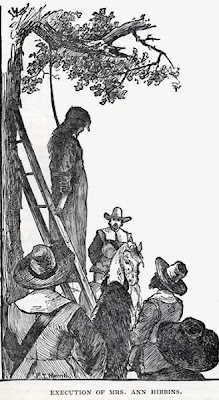
One of the books put on line by Googel is The Salem Witch Trials: a Reference Guide (by K. David Goss). It recounts the trial of Anne Hibbins who was hanged in 1656.
Anne Hibbins (1656) was censured by Boston church leaders for her contentious behavior in repeatedly accusing a local craftsman of overcharging for his labor. She was furthermore charged with supplanting her husband’s position in dealing with this problem, violating the puritan belief that wives should submit themselves to the leadership of their husbands. For this offense, she was unrepentant. She was removed from membership in the Boston church and found guilty of witchcraft in 1654 after the death of her husband. Although the magistrates denied the initial vedict, a second trial was held before the Massachusetts Great and General Court. Anne Hibbins was convicted a second time of witchcraft and executed in 1656. In his assessment of this tragedy, Governor Thomas Hutchinson, in his "History of Massachusetts," places the blame for this conviction upon the people of Boston who disliked Anne Hibbin’s contentious nature. He wrote that the trial and the condemnation of Anne Hibbins for withcraft was "a most remarkable occurrence in the colony," for he found tha is was her temper and argumentative nature that caused he neighbors to accuse he of being a wtich.
It’s very likely that Goodwife Knapp was hung for the same reasons three years earlier in Fairfield in the New Haven Colony.

The remarkable thing about the Goodwife Knapp execution is not the trial itself but the aftermath. Roger Ludlow, the Deputy Governor of Connecticut, had been fighting on and off for several years with his neighbor Mary Staples (wife of Thomas Staples, also known as Staplies). In 1651 Ludlow won a suit against Mary Staples for slander but this did not put and end to their dispute.

During the trial and imprisonment of Goodwife Knapp, Roger Ludlow and his supporters tried to get her to affirm that Mary Staples was a witch but Knapp refused. Just before the execution, Ludlow claimed that Goodwife Knapp came down the ladder and whispered in his ear that Mary Staples was, indeed, a witch.

Ludlow told this story to his friends, Rev. John Davenport and his wife, and it soon spread to the entire village of Fairfield. Accusing someone of witchcraft was a very serious charge—especially just after Goodwife Knapp had been hanged. When Thomas Staples heard that Ludlow was making these accusations against his wife he filed a defamation suit against Roger Ludlow.

The trail took place in May, 1654. There are several accounts on the internet taken from books that have recently been scanned. The best and most readable is from The Witchcraft Delusion in Colonial Connecticut by John M. Taylor. This is from the trial records and some of the descriptions are quite graphic, particularly the account of the examination of Goodwife Knapp’s body for witch’s teates.

There’s another good account in Witch-Hunting in Seventeenth-Century New England: A Documentary History 1638 ... by David D. Hall.

The role of the Sherwood family in the trial is described in A Changing America: Seen Through One Sherwood Family Line 1634-2006.

The reason for my interest in this trial is that many of my ancestors lived in Fairfield at the time and their names are mentioned in the account. Some of my ancestors were friends of the Staples and defended Mary Staples while others sided with Roger Ludlow. Ludlow lost the case and he left Fairfield the following year (1654), making his way eventually back to England and then to Ireland where he remained for the rest of his life.

My living relatives might be interested in our connections to the trial: here they are.

These are ancestors of Isabelle Hooper Burns (1862-1923) the mother of my maternal grandfather. More specifically, they are direct ancestors of her mother’s mother, Esther Treen (1807-~1891).

Here are the names of people mentioned in the defamation lawsuit. Our direct ancestors are underlined.

John Banks (1619-1784), attorney for Thomas Staples. (He is my great9-grandfather. Most of the others are from this generation or one generation earlier: great10)

Witnesses Andrew Ward (1597-1659) and his wife Hester Ward = Hester Sherman (1606-1666).

Witnesses: Goodwife Barlow = Ann Ward (?-1684) and her husband John Barlow (1599-1674)

Witness: Goodwife Sherwood = Mary Onge? second wife of Thomas Sherwood (1586-1655). Thomas' first wife, my ancestor, was Alice UNKNOWN1 (~1587-1639).

Witness: Goodwife Odell (Odill) daughter-in-law of John Odell (1574) and Joan Bingley (1581-1640).

Witness: Mr. Jones is John Jones (1591-1665).

Witness: Goodwife Lockwood is Susan (Susanna) Norman (1616-1661) wife of Robert Lockwood (1600-1658).

Witness: Deborah Lockwood (1636-?), 17 years old at the time of the trial and my great9-grandmother. She is the daughter of Robert Lockwood and Susanna Lockwood.

Witness: Thomas Lyon (1621-1690).

Witness: Rebecca (Rebecka) Hull is Rebecca Jones, wife of Cornelius Hull and daughter of John Jones (1591-1665) and Sarah UNKNOWN (1599-1650).

Witness: Thomas Barlow was the second husband of Rose Sherwood, daughter of Thomas Sherwood (1586-1655) and Alice UNKNOWN1 (~1587-1639).

Goodwife Pell is not an ancestor of mine but she has an interesting connection. She is Lucy Pell, wife of Thomas Pell who later founded Pelham, in what is now the Bronx, New York City [The Involvement of Thomas Pell's Family in the Witchcraft Persecution of Goody Knapp].


1. Usually given as Alice Seabrook but this is almost certainly wrong according to A Changing America: Seen Through One Sherwood Family Line 1634-2006, Volume 1 By Frank P. Sherwood.

The drawing of the hanging of Ann Hibbins and the map of the colonies in 1650 are from the HTY277 website of the University of Maine at Farmington.
nature science for kids,nature science definition,nature science articles,nature science jobs,nature science museum,nature science projects,nature science magazine,nature science journal nature science for kids,nature science definition,nature science articles,nature science jobs,nature science museum,nature science projects,nature science magazine,nature science journal